
Gleichschaltung is an interesting German word meaning synchronisation or coordination.
In the context of German history it was used to describe the process of Nazification in the mid-1930s; that is, establishing a system of totalitarian control and coordination over all aspects of German society.
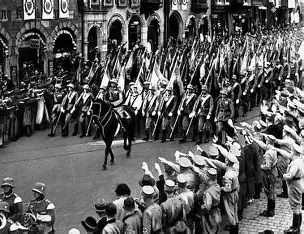
Gleichschaltung in motion
I first came across it in a piece published by the American socialist publication Monthly Review in June last year by its editor John Bellamy Foster: Gleichschaltung in Nazi Germany.
Given what is occurring internationally as well as to a much smaller extent locally, it is timely to consider what in means in both an international and Aotearoa New Zealand context.
Your generosity has the power to change lives. Every contribution—big or small—helps me continue our mission to help make Aotearoa New Zealand a better place for its people. Donate
Prescient observations
In fact, Foster‘s published piece was an excerpt from his own book Trump in the White House: Tragedy and Farce published in 2017 in the first year of Donald Trump’s first presidential term.
Although first published eight years ago Foster’s views were prescient. They foreshadowed what is now evolving in real time during the first five months of the second Trump administration controlling the world’s strongest military and economic power.
Nazi leader Adolf Hitler came to power in Germany by means of electoral success in January 1933 which led to him becoming Chancellor (prime minister).
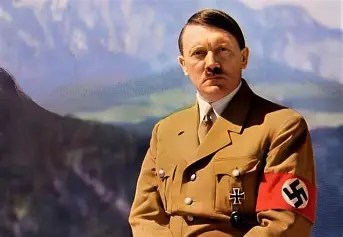
It took Adolf Hitler only two years to achieve Nazi Gleichschaltung in Germany
Although Germany’s then democratic system under the Weimar Constitution remained nominally in place throughout his dictatorship, by 1935 Hitler had achieved near total Nazification.
This included fusing the symbols of the party and the state and depriving German Jews of their citizenship.

John Bellamy Foster discusses pathway to Gleichschaltung in Germany
It is worth quoting Foster at some length to better understand how this transformation occurred:
All regimes within the fascist genus in monopoly-capitalist society have as their principal object the destruction of liberal democracy. This is effected by means of a system of coercive rule centered on a leader or demagogue around whom a mass of “stormtroopers” drawn from the lower-middle class or petty bourgeoisie is mobilized, relying on a revanchist, racist, nationalist, and patriarchal ideology. It is characteristic of fascism that corporate property and the position of the monopoly-capitalist class remain sacrosanct. Private economic power within the society becomes more concentrated, even while control of the state becomes more centralized.
Such regimes, once they have gained control of the executive branch of the state, whether by election or coup, do not rule simply through raw power, but cling to some notion of legal order as the basis of their rule, claiming to conform to a constitutional order. What would normally be considered extralegal coercion is justified in terms of various “states of exception” such as the declaration of a “national emergency” or martial law, along with the introduction of a leadership principle enhancing executive authority, allowing the usual constitutional barriers to be crossed. This process, however, requires the support or acquiescence of the larger society. Hence, consolidation of such regimes is not the work of a day. Full dominance can only be achieved through a lengthy process that in Nazi Germany was known as Gleichschaltung, meaning synchronization or falling into line, whereby the entire state apparatus and the larger cultural apparatus are brought step by step under the regime’s control.
In the destruction of the liberal democratic state, a fascist or neofascist movement needs to gain control of the executive, legislative, and judicial branches; the administrative state or civil service bureaucracy; the military and national security apparatus; police; prisons; the political party apparatus; the public education system; and, below the national or federal level, regional and local governments. However, Gleichschaltung does not stop with the conquest of the state apparatus but necessarily extends to the entire cultural apparatus of society, including the media, the educational system as a whole (both public and private), the wider legal sphere (lawyers and law schools), trade unions, the sciences, and the arts—eliminating all areas of critical thought and potential opposition.
United States on “brink of authoritarian takeover”
Francine Prose is a former president of PEN American Centre (part of a global organisation promoting friendship and cooperation among writers) as well as being a member of both the American Academy of Arts and Letters and the American Academy of Arts and Sciences.
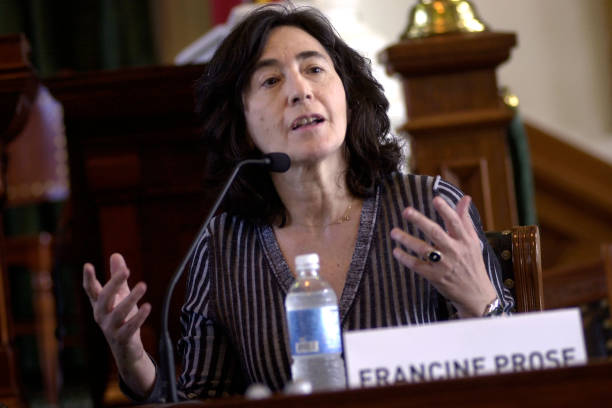
Francine Prose rings Gleichschaltung alarm bell (Getty Images)
On 26 January, without actually using the word, she published a warning about the Trump-led United States’ direction towards its own version of Gleichschaltung in the The Guardian: A country on the brink of an authoritarian takeover.
In her words:
There is one story: our country is on the brink of an authoritarian takeover. In Minneapolis an innocent poet and an ER [emergency] nurse at a VA [Veterans Affairs] hospital were both killed in cold blood by federal agents. It is happening now. Toddlers are being sent to detention centers; videos of their gyms for kids recall the youth choruses that the Nazis so proudly showed off at the Terezín concentration camp. Intimidation and violence are being weaponized against the citizens of Minneapolis, some of whom are afraid to leave their houses for fear of being beaten, arrested and shackled, regardless of whether they are US citizens or asylum seekers or people from another country peacefully living and working here for decades.

Donald Trump has made immigrants in US like Jews in 1933-35 Germany
Further on:
The story – masked agents, arrests, violence, kidnappings, deportations without due process – is happening all over the country, but in smaller increments, without as much pushback, and so far without the death of two innocent, middle-class, white bystanders. The story is about how decent and unselfish Renee Good and Alex Pretti were and about the falsehoods being told about them.
The story is not letting ourselves be distracted from the real and present threat to our democracy. That threat is the story which our print, electronic and social media should be bannering at the top of every feed and every front page, every day. To consistently run that below the weather report is, quite frankly, to betray the struggles of the people of Minneapolis.
The story is what we do now to support our fellow Americans in the midwest and to keep the violence and repression from spreading even further into our own streets and backyards.
Insightful perspective from within neoliberal rightwing
To put this Gleichschaltung in a New Zealand context I found it helpful to start with two recent articles published in Newsroom by Oliver Hartwich.
He is the Executive Director of the rightwing neoliberal thinktank, the New Zealand Initiative. Even though he isn’t writing about my specific context, his insights provide some resonance.

Oliver Hartwich provides a helpful insight into far right growth from a concerned rightwing perspective
The first article (27 January) focusses more on Donald Trump who, he argues with some validity, is too chaotic and insufficiently ideologically motivated to be compared with Adolf Hitler: Donald Trump, the Kaiser in Mar-a-Lago.
The second article (24 March) laments the rise of the far right throughout the world, particularly the United States (Trump’s MAGA), United Kingdom (Reform) and Europe (including in his homeland Germany): Liberal democracy suffers great leap backward.
Your generosity has the power to change lives. Every contribution—big or small—helps me continue our mission to help make Aotearoa New Zealand a better place for its people. Donate
Is far right cannibalising New Zealand‘s mainstream rightwing doable?
While not in full agreement with Hartwich’s analysis (some of what he labels ‘liberal democracies’ are not necessarily that liberal or democratic) there is much in it to commend. Nevertheless, I do prefer my own earlier analysis in Political Bytes (3 November): Far right cannibalising mainstream rightwing.
After discussing the behaviours of smaller coalition government parties, ACT and NZ First, I described the cannibalisation of the mainstream rightwing by the far right in Europe.

Nigel Farage leads high polling far right Reform in UK
This included post-Nazi Germany where the previously small Alternative für Deutschland (AfD) is now the second largest party in the federal parliament (Bundestag) and the United Kingdom where the far right Reform party is currently topping the polls.
I requoted Tarik Abou-Chadi, Associate Professor of European Politics at Oxford University:
We’re in a vicious cycle. It starts with the radical right being more successful, winning more seats, entering government in more countries…mainstream parties move right on immigration. It’s strategic, to win back votes. So you have this accommodation. Except it doesn’t work – it doesn’t bring the votes back.
However, all this accommodation does, he argues is normalise and legitimise the far right with increasing numbers of voters preferring the far right original than its ‘copy-cats’.
Blending of neoliberal and far right politics
I ended my above-mentioned post by discussing the implications of this cannibalisation process in the context of New Zealand politics.
Specifically this was whether, within the current coalition government, the larger mainstream rightwing National Party, which already includes internal hard right influence, might be cannibalised by NZ First and/or ACT.
There is an obvious difference. While increasingly hard right, neither ACT nor NZ First can be reasonably characterised as far right.
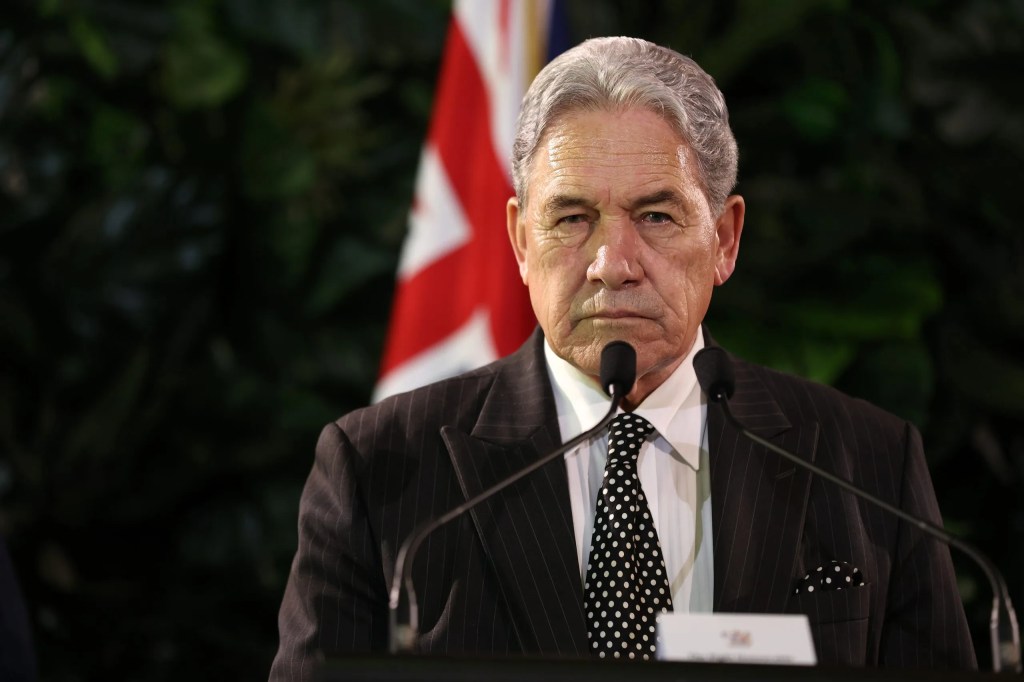
NZ First under Winston Peters has evolved from mainstream right to hard right
NZ First began over three decades ago with a xenophobic binge against Asian immigration. Nevertheless, until recently, it was a more mainstream rightwing political party with economic nationalist and populist edges.
However, NZ First has migrated to the rightwing extreme as it seeks to attract and consolidate the small but significant electoral base this provides. It is Trump-light rather than Trump-tight. Its main point of difference with National and ACT is its support for more state involvement in the economy.

Under David Seymour ACT has evolved from libertarian to corporate culture
First elected to Parliament in 1996 ACT began as a strictly libertarian party advocating neoliberalism. But overtime it has evolved from so-called market freedom to actual corporate culture and control.
Its current leader David Seymour even has developed a respectful approach towards New Zealand’s most prominent far right leader (in my view fascist) Brian Tamaki of the Destiny Church.
This is indicative of a blending from within neoliberalism to authoritarian extremism. However, not all neoliberals should be characterised as being part of this blending.
Genuine believers such as Oliver Hartwich and many others (including some I know personally and have friendly relations with) who are shaped by the libertarian ideology of neoliberalism are appalled by increasing authoritarianism cannibalisation of the political right.
But as can happen within many ideologies (right or left), a zealous ‘ends justify the means’ mentality can emerge.
This is especially when it leads adherents to believe that property rights and market forces have primacy over democracy, whether formal or substantive.
Neoliberalism and the far right are not in each other’s ‘bed’ but some adherents of the former can metaphorically sleep around with the latter.

Neoliberalism introduced into Chile under General Augusto Pinochet’s murderous dictatorship
An obvious and murderous example, and the most well-known, is the adoption of neoliberal economic policies by General Augusto Pinochet who was the military dictator of Chile for 17 years following a violent coup in 1973.
Aside from neoliberalism, his dictatorship was characterised by mass brutal persecution and murder of political opponents.

Neoliberal Tony Blair supports authoritarian regimes and far right Donald Trump
Tony Blair was the Labour Party Prime Minister of the United Kingdom for 10 years from 1997. Rather than turn around the rampant neoliberalism of Conservative prime minister Margaret Thatcher, he not only continued it; he took it further.
Further, Blair deceitfully worked ‘hand-in-hand’ with then United States Republican president George W Bush in pursuing the disastrous and murderous Iraq war.
These days his controversial ‘foundation’ has authoritarian regimes such as Saudi Arabia as major donors and he praises the far right leadership of Donald Trump; they are kindred spirits.
The Prime Minister of India is far right extremist Narendra Modi who previously, as a state governor, was responsible for a massacre of minority Muslims. His government has adopted neoliberal policies.
Gleichschaltung Kiwi style?
ACT’s occasional dalliance or sleep-over with the Destiny Church is nowhere near being in the same league as Pinochet, Blair and Modi. Similarly NZ First’s identification with the far right MAGA in the US is more bravado than full congruence at least at this stage.
The National Party at serious risk of being cannibalised by both its rightwing coalition partners (especially NZ First). However, at this point at least this does not constitute a far right cannibalism.
AfD was a small insignificant far right party not that not long ago
But political dynamics can be fast moving. It is not that long ago that Reform in the United Kingdom and AfD in Germany were small largely insignificant parties. The same can be seen in several other European countries such as Vox in Spain.
New Zealand is a long way away from Nazi Germany in 1933. We are also long way away from having a Gleichschaltung. But, when certain stars align, the unexpected can occur very quickly.
Donald Trump has succeeded by both synchronisation and coordination over the past nearly 18 months in turning immigrants in the United States into the Jews of Nazi Germany in 1933-35.
A tipping point leading to our own Gleichschaltung should not be dismissed out-of-hand even if the recipe’s ingredients might be different.
It is not just the political left that needs to be alert to this. So does the compassionate political right including those who genuinely believe in neoliberalism ideology.
Do some of the seeds of authoritarianism reside within neoliberalism? Perhaps this is the subject of another post. Just saying!
Your generosity has the power to change lives. Every contribution—big or small—helps me continue our mission to help make Aotearoa New Zealand a better place for its people. Donate
Recent Political Bytes Posts
- When a golden handshake isn’t a golden handshake (18 May).
- NZ silence over inhumanity of US economic sanctions against Cuba, including rising infant mortality (9 May).
- Wellington floods, climate change, wealth accumulation and suicidal capitalism (2 May).
- Making sense of Opportunities Party (14 April)
- US warfare against Cuba (25 March).


8 thoughts on “Gleichschaltung and the far right momentum: lessons for New Zealand”