
With some origins in ‘Athenian democracy’ free speech is one of the noblest rights which people have struggled for and defended in a multitude of ways for centuries.
Put simply it is the right to express any opinions without censorship or restraint. Particularly with such a broad principle, this right is not absolute when one moves from the abstract to the practical.
Free speech is not free when it is narrowly seen as simply ‘me’ rather than more broadly as ‘we’. It is not when it is used to override the free speech of others or duties of responsibility.
Defamation immediately comes to mind; the right to free speech does not override the right not to be defamed or the responsibility not to defame.

The cloak of hypocrisy covers supposed free speech advocates
Hypocrisy is the practice of claiming to have higher standards or more noble beliefs than is the case.
An example is when those who purport to be the advocates for free speech also seek to curtail the free speech of others of different perspectives to theirs.

Ben Tomsett’s report reveals free speech hypocrisy by supposed free speech advocates
This hypocrisy was well illustrated on 3 June in an article by NZ Herald multimedia journalist Ben Tomsett: Complaint against Otago University Vice Chancellor over personal views on woman and man definitions bill.
The ‘sin’ of Grant Robertson
The self-styled Free Speech Union has complained to Otago University over its Vice Chancellor Grant Robertson both expressing his personal views on a NZ First parliamentary bill seeking to define what is a woman and what is a man and for his assessment on the 2026 Budget as it impacted universities.
The Bill, in the name of MP Jenny Marcroft, passed its first reading in Parliament and is now before a select committee: Amendment bill.
The Bill endeavours to simplistically define a ‘woman’ in law as an ‘adult human biological female’ and a ‘man’ as an ‘adult human biological male’.
Aside from being a solution desperately in search of an invisible problem, if adopted into law it would overtly discriminate against transgender, intersex and non-binary New Zealanders. Bigotry would be the only beneficiary if it became law.
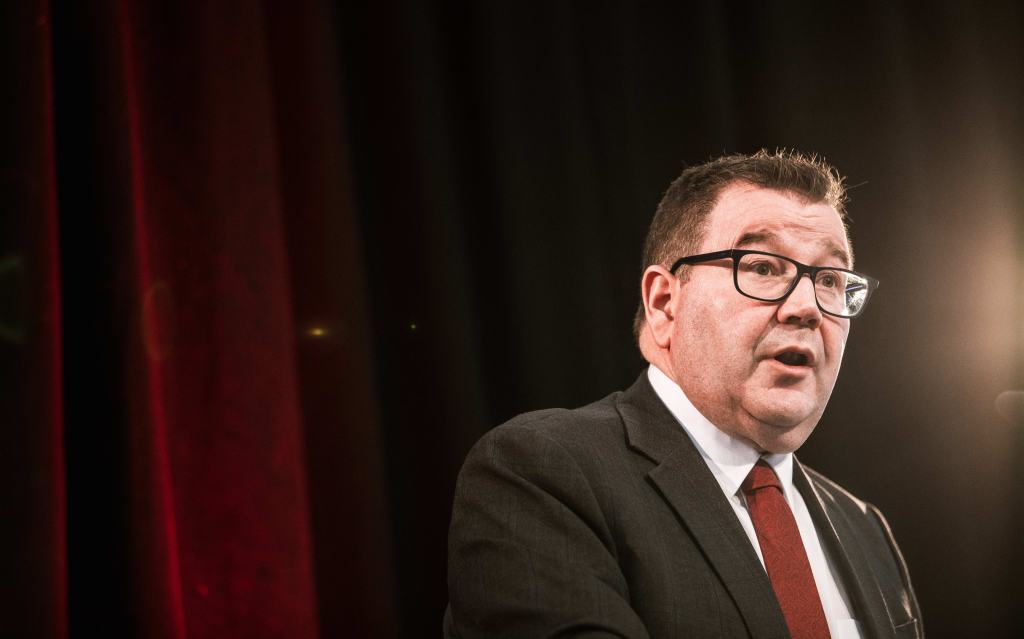
Grant Robertson ‘guilty’ of expressing a personal view on controversial anti-trans proposed legislation and criticising Budget on universities
Although Otago University Vice Chancellor, Grant Robertson is more publicly known as a former longstanding Labour Party MP, Finance Minister and Deputy Prime Minister.
Robertson’s ‘sin’ that led to the Free Speech Union’s formal complaint was committed in a recent email to the university community discussing student wellbeing and support services ahead of exams. It was clearly expressed as a duty of care to students.
Included within the email was a brief comment, more of an aside, on the above-mentioned parliamentary bill. It was explicitly referred to as a personal opinion as distinct from a formal university position.
In Robertson’s own words:
I know this Bill will be upsetting for many in our Otago community – particularly those who identify as, and love and support our trans, intersex, takatāpui, gender diverse and non-binary whānau. At a personal level, I find this legislation to be unnecessary and disturbing.
Tomsett notes that Robertson added that “as a university we remain resolute in upholding our commitments to respect and inclusion” and that he directed students to support services including Student Health and Te Pou Whirinaki.
Robertson was critical of the Budget as it affected universities. This is not unusual for vice chancellors; indeed there is an expectation they should when this is their considered conclusion.
He acknowledged “some positives” before advising that the Budget was:
…overall a lean budget for our sector….seeks to shift even more of the burden of the cost of education in the future on to you.
Defending the indefensible

Splitting hairs to fudge an ideological rightwing position
The Free Speech Union resorts to splitting hairs to rationalise its complaint against Grant Robertson. Spokesperson Steph Martin explained it this way:
The issue is taking an institutional position on a strongly contested political question. When the Vice-Chancellor signs his views with his title and sends them through the University’s own channels, the institution speaks with him – and staff and students who take a different view are left on the wrong side of an official line.
A university stays open by not announcing, from the chair, which side of a contested question its members should be on.
We take no position on the merits of the Bill or the Budget.
Reasonable New Zealanders will hold a range of perspectives on both, including at Otago. The point is that a university should be a place where they can disagree – including with their Vice-Chancellor.
This flimsy argument falls down on several grounds including:
- nothing in Robertson’s comments explicitly or implicitly threatens or erodes the free speech of anyone, including students;
- the email was from a responsible vice chancellor expressing a wellbeing ‘duty of care’ for students at a potentially stressful academic time;
- nothing in the comments complained about prevents students or other people from disagreeing with him:
- the comment on the NZ First parliamentary bill is clearly identified as a personal view. Further, it is also directly relevant to the theme of wellbeing; and
- complaining about Robertson for expressing his concerns about university funding in the Budget is an attack on his right (and Otago University’s) to free speech and to his responsibility as a vice chancellor.
Time for honesty
Rightly so Otago University has rejected the complaint as having no legitimacy. Although it will never admit it, the Free Speech Union is part of the political right which shapes its approach.
Its rationale for this attempt to restrict the scope of what a vice chancellor might say confirms that its rightwing politics is a bigger driver than any concern about free speech itself.

Free speech is used as a false argument against duty of care responsibility
Attacking Grant Robertson for exercising his duty of care for student wellbeing crassly exposes the cloak of hypocrisy that the Free Speech Union hides beneath.
It would be the honest thing for the Free Speech Union to rename itself as the ‘Selective Free Speech Union’ or the ‘Free Speech for the Political Right Union’. Just saying!
Recent Political Bytes Posts
- Gleichschaltung, far right movement and New Zealand (1 June).
- When a golden handshake isn’t a golden handshake (18 May).
- NZ silence over inhumanity of US economic sanctions against Cuba, including rising infant mortality (9 May).
- Wellington floods, climate change, wealth accumulation and suicidal capitalism (2 May).
- Making sense of Opportunities Party (14 April)


The position of the Pseudo Free Speech cabal looks as robust as a uniquely formed, intricate, individual, delicate snowflake. The irony and hypocrisy.
LikeLike